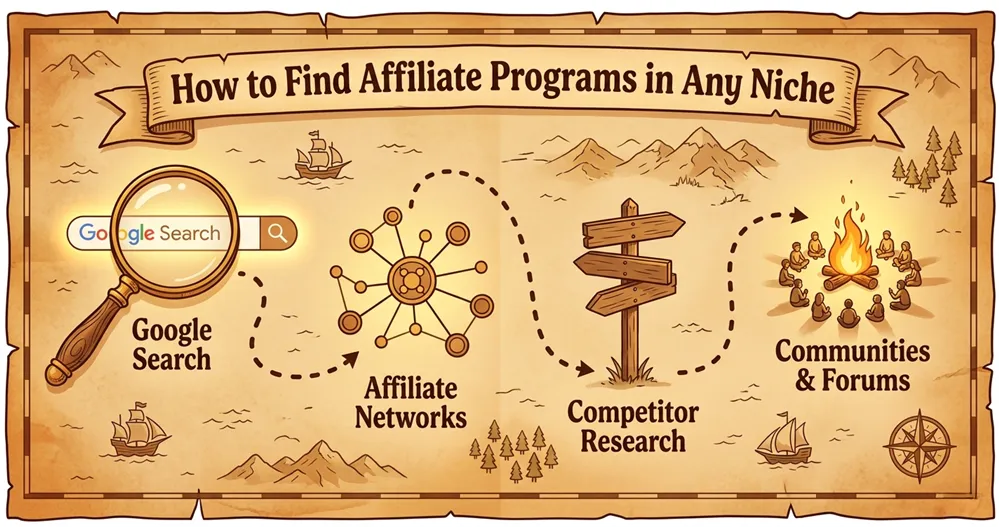
So you’ve picked your niche. Maybe you’ve even started thinking about your content. And then it hits you – how exactly do you find products to promote?
It’s one of those things that sounds simple until you’re actually sitting there trying to figure it out. You know affiliate marketing involves promoting products and earning a commission, but nobody really tells you where to go to find those products in the first place.
Do you just Google it?
Sign up for something?
Wait for companies to come to you?
If that’s where you are right now, you’re not behind. This is genuinely one of the most common sticking points for beginners, and it’s a lot simpler to solve than it seems.
In this article, I’m going to walk you through the main ways to find affiliate programs in just about any niche, from quick Google searches to dedicated networks that have thousands of programs under one roof.
By the time you’re done reading, you’ll have more than enough options to start finding products that are a real fit for your audience.
This post may contain affiliate links. ThriversHub earns commissions at no extra cost to you when purchases are made through links on this page. For more info, visit the disclosure page.
What Are You Actually Looking For?
Before you start searching, it helps to know that affiliate programs come in two main forms, and you’ll run into both as you explore your niche.
The first is a direct affiliate program. This is when a company runs its own program in-house.
You apply through their website, get approved, and they give you a unique link to promote their product. Everything is handled by the company directly – your tracking, your commissions, your payments.
The second is an affiliate network. Think of this as a marketplace where hundreds or even thousands of companies list their affiliate programs in one place.
Instead of hunting down each company individually, you join the network and get access to all of them from a single dashboard.
Neither one is better than the other. Some of the best programs you’ll ever promote are direct programs that aren’t listed anywhere except the company’s own website. But networks make the discovery process a lot faster, especially when you’re just starting out and trying to figure out what’s even available in your niche.
As you go through the methods below, you’ll come across both types. Knowing the difference upfront means you won’t be confused when one company sends you to their own signup page and another points you to a network you’ve never heard of.
Method 1: Google Search (The Direct Approach)
This is the most straightforward place to start, and it works in almost every niche.
Open up Google and type in your niche or the type of product you want to promote, followed by the words “affiliate program.” That’s really all there is to it. Here are a few examples of what that looks like in practice:
- “home gardening affiliate program”
- “personal finance affiliate program”
- “yoga gear affiliate program”
- “travel booking affiliate program”
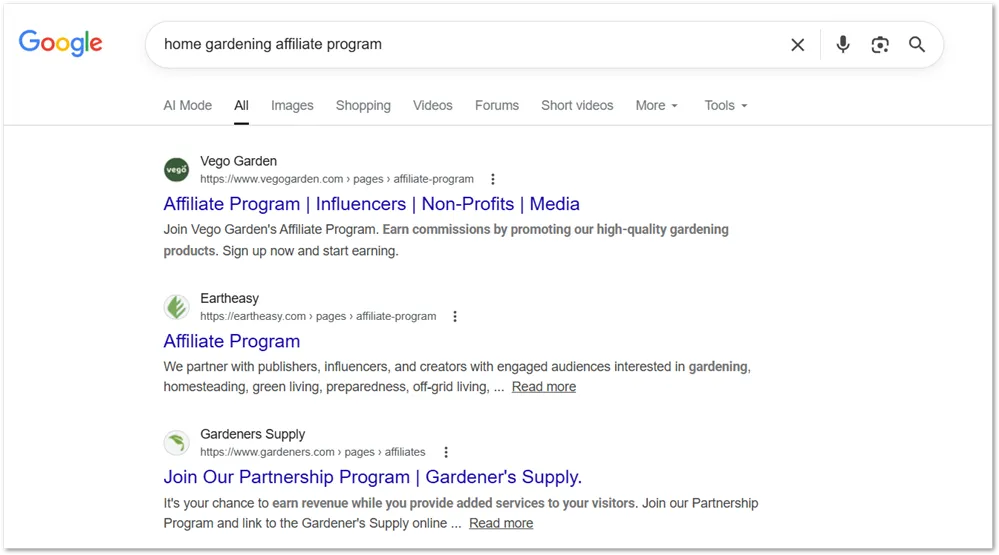
What comes back is usually a mix of individual company programs and roundup articles listing the best programs in that niche.
Those roundup articles are especially useful because someone has already done the legwork of pulling options together in one place, and they often include details like commission rates and cookie durations so you can compare at a glance.
For example, I’ve written roundup posts for affiliate programs on ThriversHub and you might come across them while searching. Here’s what some of those roundups look like:
- 14 Best Gardening Affiliate Programs
- 15 Best Gaming Affiliate Programs
- 17 Best Pet Affiliate Programs
- 11 Top Hiking Affiliate Programs
From there, it’s just a matter of clicking through, reading the details, and deciding which ones are worth applying to.
One thing to keep in mind – just because a program shows up at the top of Google doesn’t mean it’s the best one. It might just mean they’ve invested in their SEO or their affiliate recruitment. Always read the fine print before you sign up for anything.
This method works well when you already have specific brands or products in mind. But if you want to cast a wider net and see everything available in your niche at once, that’s where affiliate networks come in.
Method 2: Browse Affiliate Networks
If the Google method is about finding specific programs, affiliate networks are about seeing the full landscape of what’s available in your niche all at once.
An affiliate network is a platform that brings together merchants who want affiliates and affiliates who want programs to promote. You create one account, and from there you can browse and apply to hundreds (sometimes thousands) of programs without having to track down each company individually.
Some of the biggest and most well-known networks include:
- Amazon Associates – Covers just about every physical product category imaginable. Commissions are lower than most, but the sheer range of products makes it a common starting point for beginners.
- PartnerStack – Focused mainly on SaaS and software products. A solid choice if your niche is in the tech or online business space.
- CJ Affiliate – Tends to attract larger, more established brands. Great for finding programs from companies you’ve already heard of.
- ClickBank – Heavily focused on digital products like courses, ebooks, and software. Popular in niches like health, fitness, and online business.
- Impact — Growing fast and home to a lot of well-known brands across multiple categories.
The process is pretty much the same for all of them. You sign up for the network, browse the available programs in your niche, apply to the ones that look like a good fit, and wait for approval. Some programs approve you instantly while others review your application manually.
The advantage here over the Google method is that everything is in one place. Your stats, your links, and your payments are all managed through the network dashboard instead of scattered across a dozen different company portals.
One network I personally keep coming back to is FlexOffers. It’s not as talked about as some of the bigger names, but it has thousands of programs across a wide range of niches and is relatively easy to get started with.
What makes it a little different from the others is that FlexOffers operates as a sub-affiliate network, meaning they’ve partnered with other networks to bring programs under one roof. So you’ll sometimes find programs on FlexOffers that also exist on other networks, which can actually work in your favor when you’re trying to consolidate everything in one place.
A good approach when you’re starting out is to pick one or two networks that seem like the best fit for your niche and get comfortable with those before branching out to others.
Method 3: See What Your Competitors Are Promoting
Here’s something a lot of beginners overlook – other websites in your niche have already done a ton of research for you.
If someone is running a blog or content site in the same space you’re entering, there’s a good chance they’ve already figured out which affiliate programs are worth promoting. And in most cases, they’re not hiding it. Affiliate links are usually right there in the content, in product roundups, in comparison articles, and in resource pages.
The simplest way to do this is to find a few established sites in your niche and just read through their content with your eyes open. When you see a link to a product or service, hover over it. If the URL contains words like “ref,” “affiliate,” “partner,” or a tracking ID, that’s an affiliate link. Follow it and see where it goes. Most of the time it’ll take you straight to the merchant’s site where you can find their affiliate program and apply.
Another place to look is a site’s resource or tools page. A lot of bloggers and content creators keep a dedicated page listing everything they use and recommend. These pages are goldmines because they’re essentially a curated list of programs that are already working for someone in your niche.
You’re not copying what they’re doing. You’re using their research as a starting point for your own. From there you still need to evaluate each program yourself and decide if it’s genuinely a good fit for your audience.
Method 4: Look Inside Communities & Forums
This one is underrated, and it’s worth spending some time on.
Online communities like Reddit, Facebook groups, and niche forums are where real people talk about what’s actually working for them. And if you know how to look, you can find some genuinely useful information about affiliate programs that you might never have stumbled across through a Google search.
On Reddit, there are subreddits for almost every niche you can think of, plus dedicated spaces like r/affiliatemarketing where marketers share experiences, ask questions, and occasionally recommend programs they’ve had good results with. You’re not looking for someone to hand you a list – you’re looking for patterns. If a particular program keeps coming up in conversation, that’s worth paying attention to.
Facebook groups work in a similar way. Search for groups related to your niche or to affiliate marketing in general, join a few of the active ones, and just spend some time reading through the posts and comments. People ask questions like “has anyone promoted X program?” or “what’s the best affiliate program for this niche?” all the time. The responses can point you toward options you hadn’t considered.
Niche forums are a bit older school but still valuable depending on your topic. If your niche has an active forum community, the threads there can give you a sense of which products and services people in that space actually trust and use which is exactly the kind of thing you want to know before you start promoting something.
One thing to keep in mind with all of these – take individual recommendations with a grain of salt. Someone singing the praises of a particular program might be an affiliate themselves. That doesn’t make the recommendation useless, but it’s worth doing your own research before you commit.
What To Look For in a Good Affiliate Program
Finding a program is one thing. Knowing whether it’s actually worth promoting is another.
Not all affiliate programs are created equal, and signing up for the wrong one can mean spending time and energy creating content that barely pays off. Here’s what to pay attention to before you commit.
Commission rate
This is the percentage or flat fee you earn every time someone makes a purchase through your link.
Higher isn’t always better. A 50% commission on a $10 product is still only $5. Think about commission rate alongside the price of the product to get a realistic sense of what you’d actually earn per sale.
Cookie duration
When someone clicks your affiliate link, a cookie is placed in their browser that tracks them back to you if they make a purchase.
Cookie duration is how long that tracking window stays active. A 24-hour cookie, like Amazon’s, means if someone clicks your link but buys two days later, you get nothing. A 30, 60, or 90-day cookie gives you a much better chance of earning the commission.
Product quality
This one matters more than people give it credit for. If you promote something that lets your audience down, that reflects on you, not the merchant. Before you promote anything, make sure it’s something you’d genuinely recommend to a friend.
Merchant reputation
Look up the company before you sign up. Check reviews, look at how they treat their customers, and see if there are any complaints from other affiliates about delayed payments or unethical practices. A high commission rate means nothing if the merchant isn’t reliable.
When I was just getting started in affiliate marketing, I jumped at the chance of promoting an affiliate program that paid $50 per sale for VoiP signups. I made over $700 in commissions but could not get paid for more than a year along with other affiliates. A simple search before promoting could have saved the frustration.
Affiliate support and resources
Good programs make it easy for you to promote them. That means providing banners, email swipes, product images, and sometimes even dedicated affiliate managers you can reach out to.
It’s not a dealbreaker if these are minimal, but it’s a good sign when a merchant clearly invests in their affiliate relationships.
Finding Programs Is Just The Starting Point
Now that you know where to look, the options are going to feel a lot less overwhelming.
Whether you start with a simple Google search, browse a network like FlexOffers or ClickBank, reverse-engineer what competitors are promoting, or dig into community discussions, there’s no shortage of programs to explore in just about any niche.
But here’s something I want you to keep in mind as you go through this process – finding a program is just the first step. The real work is building an audience that trusts you enough to act on your recommendations. That means creating content consistently, understanding what your readers actually need, and learning how to position the products you promote in a way that feels natural rather than forced.
That’s a bigger conversation than one article can cover, and it’s exactly what I built ThriversHub around. But if you’re looking for a place to learn all of it in a structured way, from picking your niche and building your site to finding programs and actually making sales then Wealthy Affiliate is the place you need to be.
I’ve been a member since the early days of my affiliate marketing journey, and it’s one of the few platforms I keep coming back to. They have training, tools, and a community of marketers at every level.
One of the best things about Wealthy Affiliate is that you can get started for free without handing over a credit card.
If you’re serious about building this the right way, it’s worth taking a look.