Most people who start teaching ESL online make the same pricing mistake in their first month.
They charge too little.
Not because they are trying to be generous. Not because they calculated their worth and decided on a number. They charge too little because they are nervous. They worry that no one will pay more. They look at what platforms pay and think, “I guess that’s what I’m worth.”
Here’s what happens next.
They book students at $10 or $12 per hour. They teach back-to-back lessons. The schedule fills up fast, which feels good at first. But then the math hits. After a full week of teaching, the income does not match the effort.
The problem is not the teaching. It’s the price.
When you underprice your lessons, you don’t just earn less money. You attract students who expect cheap. You make it harder to grow. And you send a message to the market that your time and expertise aren’t valuable.
Pricing is not just about numbers. It is about positioning.
The way you price tells students what kind of teacher you are. It signals quality, commitment, and professionalism.
This is why getting your pricing right is one of the most important decisions you will make as an independent ESL teacher.
If you want to stop trading hours for pennies and start building real income, this is where it begins.
This post may contain affiliate links. ThriversHub earns commissions at no extra cost to you when purchases are made through links on this page. For more info, visit the disclosure page.
Common ESL Pricing Models

Before you can price with confidence, you need to know your options.
Most independent ESL teachers use one of three main pricing models. Each one works differently, attracts different types of students, and impacts your income in its own way.
Let’s break them down.
Per Lesson Pricing
This is the simplest model. Students pay for one lesson at a time.
This model works well when you are just starting out. It gives students a low-risk way to try you out.
But there is a downside.
Income becomes unpredictable. Some weeks you might have ten lessons booked. Other weeks, three.
Per lesson pricing is fine for beginners. But if you want steady income, you will need to move beyond it.
Package Pricing
This is where you sell lessons in bundles.
Packages create more stability. You get paid in advance, which means predictable cash flow. Students who pay upfront are more committed. They show up more consistently because they have already invested.
This is one of the most popular models for independent teachers because it balances flexibility with structure.
Monthly Subscription Plans
This is the model that creates the most income stability.
Subscriptions work like a membership. The student is locked in, and payments happen automatically each month. You know exactly how many students you have and how much income is coming in.
This model works best once you have built trust and credibility. Students need to believe you are worth committing to long term. But once you have a handful of monthly subscribers, your income becomes far more predictable.
Which Model Should You Use?
The answer depends on where you are in your business and what kind of students you want to attract.
You do not have to pick just one. Many successful teachers use a mix. They offer single lessons for new students, packages for those who want flexibility, and monthly plans for serious learners.
The key is understanding what each model does for your income and your schedule. Once you see that clearly, choosing becomes much easier.
How To Choose The Right Model
Now that you know the three main pricing models, the next question is obvious.
Which one should you actually use?
The answer is not the same for everyone. It depends on two things: the niche you teach and the type of students you want to attract.
Let’s walk through how to match your pricing model to your business.
Start With Your Niche
The way you price should match what your students need.
If you teach business English to working professionals, your students probably want consistent progress. They need regular lessons to stay sharp and improve over time. A monthly subscription plan makes sense here. It gives them structure, and it gives you reliable income.
If you teach test prep like IELTS or TOEFL, students are working toward a specific goal with a deadline. They need focused, short-term support. Packages are perfect for this. You can sell a six-lesson or ten-lesson package designed to get them ready for their exam. It feels goal-oriented, and they can see exactly what they are paying for.
Your niche tells you what kind of commitment your students are ready to make. Match your pricing model to that reality.
Think About Student Commitment Level
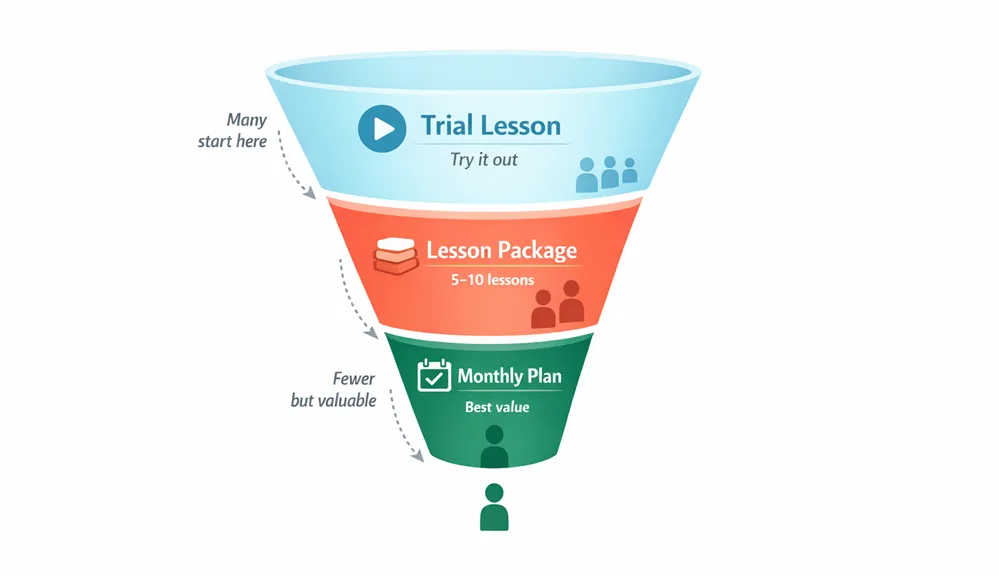
Not all students are ready to commit the same way. Here is the mistake most teachers make.
They assume everyone wants the cheapest, easiest option. So they only offer per lesson pricing. But when you do that, you leave money on the table. Some students actually prefer the structure and accountability of a monthly plan. If you never offer it, they will never buy it.
The solution is simple. Offer more than one option.
Give new students a way to try you out. Give committed students a way to lock in long-term. Let people choose what fits their goals and budget.
Consider Your Own Schedule and Income Goals
Your pricing model also needs to work for you.
If you are teaching part-time and you want predictable income, subscriptions and packages should be your focus. They reduce the time you spend chasing bookings and give you a clear picture of what you will earn each month.
If you are still figuring out your schedule or you want maximum flexibility, per lesson pricing gives you room to adjust. You can teach more some weeks and less others without worrying about fulfilling commitments.
Think about how many students you want and how many hours you can realistically teach each week. Then choose the model that helps you hit your income target without burning out.
For example, if your goal is $500 per month and you charge $25 per lesson, you need twenty lessons. That is five lessons per week. If you package those into monthly plans at $125 per month, you only need four committed students. Four students are easier to manage than twenty one-time bookings.
See how the model changes everything?
Start Simple, Then Add Layers
If you are brand new, do not overthink this.
Start with per lesson pricing to get your first few students. Learn what they need. Build confidence. Once you have a couple of regular students, introduce a package option. See how they respond.
Pricing models are not set in stone. You can adjust as you grow. The important thing is to start with something that feels manageable and makes sense for the students you are trying to reach.
Once you have that foundation, everything else gets easier.
Final Words
Pricing is one of the hardest parts of running your own ESL business.
But it is also one of the most important.
When you price with confidence, you attract better students. When you build recurring income, you stop chasing bookings every week. And when you add value beyond just showing up for lessons, you create something that lasts.
Sustainable always beats cheap.
You are not trying to be the lowest-priced teacher on the internet. You are building a business that supports your life and gives you freedom. That starts with charging what you are worth and structuring your offers in a way that creates stability.
If you are ready to take the next step and build your own independent ESL teaching business from scratch, check out our complete guide on how to start your own online ESL teaching business. It will walk you through everything you need to get started, find students, and grow your income on your own terms.
Your time is valuable. Price like it.