What if the real reason you struggle to get ESL students has nothing to do with your teaching skills, your accent, or how crowded the market feels?
Most teachers start by looking for platforms because it feels safe. Platforms promise students, structure, and simplicity. You sign up, create a profile, and wait. When students do not come, it is easy to believe the problem is outside your control.
But the truth is simpler and more empowering.
Getting ESL students is not luck. It is not about being early, popular, or loud online. It is a learnable skill. And once you learn it, you are no longer dependent on any marketplace, algorithm, or third party rules.
This article shows you how independent teachers attract students without teaching platforms. Not through shortcuts or hype, but through systems that work quietly in the background. Systems that build ownership, stability, and long-term growth.
If your goal is to build a real online ESL teaching business, this is the missing piece most platforms never tell you about.
This post may contain affiliate links. ThriversHub earns commissions at no extra cost to you when purchases are made through links on this page. For more info, visit the disclosure page.
Why Social Media Alone is Not Enough
Social media feels like the obvious place to start when you want ESL students. It is free, fast, and full of people. You post a tip, a reel, or a short video and hope the right student sees it.
Sometimes it works. Most of the time, it does not.
The problem is not effort. The problem is how social media actually works.
Short Lifespan
Most social media content disappears almost as soon as it is posted. A video might get attention for a few hours or a few days, then it is buried under new content. Even a post that performs well has a very short life.
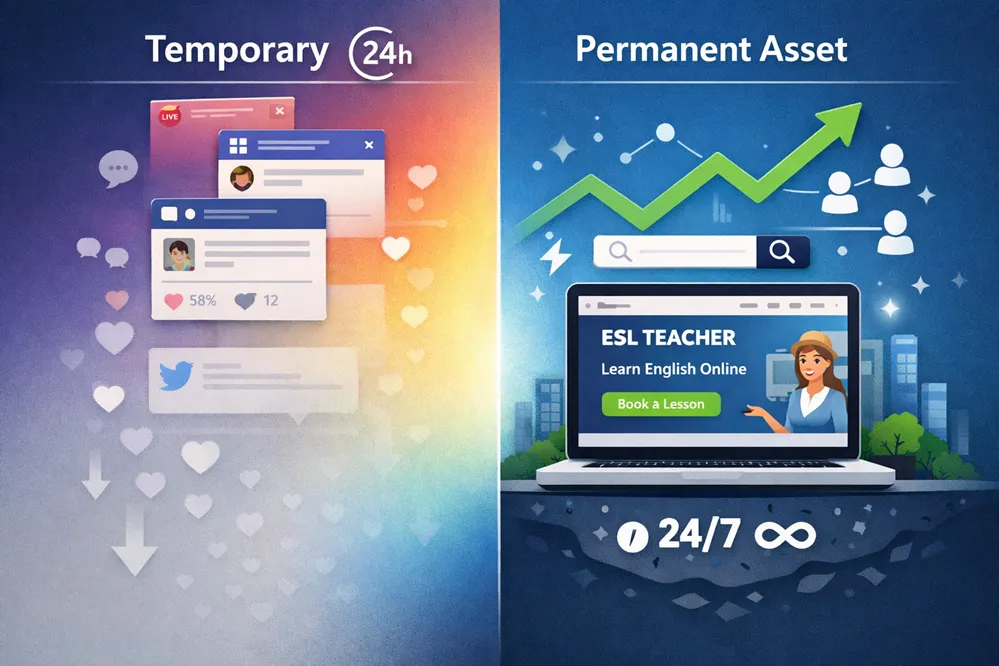
This means you are always starting over.
If you stop posting, your visibility drops. If you take a break, student inquiries slow down. Your results depend on constant activity, not on the value you already created.
For teachers trying to build something stable, this is exhausting. You are trading time and energy for temporary exposure instead of building an asset that keeps working for you.
Inconsistent Reach
The second problem is about how much control you actually have. You do not control who sees your content.
Algorithms decide what gets shown, when it gets shown, and who sees it. One week your posts reach hundreds of people. The next week, almost no one sees them. Nothing about your teaching changed, but the results did.
This makes planning difficult. You cannot predict student flow or income when reach is inconsistent. You also cannot rely on social media alone to fill your calendar with serious, ready-to-learn students.
Social media can support your business, but it is not a foundation. Without something more stable underneath, you are always chasing attention instead of building momentum.
How Students Actually Search for ESL Help
To attract students without platforms, you have to understand how real students look for help. Most are not scrolling social media hoping to find a teacher. They are searching because they have a problem they want to solve.
This shift in mindset changes everything.
Google Behavior
When someone needs ESL help, they usually turn to Google. They type questions like:
- “How can I improve my English speaking?”
- “Online English teacher for adults”
- “English lessons for beginners”
These searches are not casual. They come from frustration, deadlines, or clear goals. The student is not browsing. They are actively looking for an answer.
This is important because Google works differently than social media. Content does not disappear in a few hours. A helpful page can show up in search results for months or even years.
Instead of chasing attention, you place yourself where students are already looking.
High-Intent Searches
The biggest advantage of search traffic is intent. A person searching for ESL help is far closer to becoming a student than someone watching a random video.
They want clarity. They want guidance. They want to know who can help them and how to get started.
When your content answers their exact question, trust starts to build before you ever speak to them. By the time they reach out, they already see you as a solution, not just another teacher.
This is why independent teachers who understand search behavior focus less on going viral and more on being useful. One steady stream of high-intent visitors is more powerful than thousands of views that lead nowhere.
Learning how students search is the first step toward attracting them on purpose.
Using a Website To Attract Students
A website is where everything comes together. It isn’t just a place to list your services. It is the bridge between a student’s problem and your solution.
When done right, your website works even when you’re sleeping or out enjoying yourself.
Create Content That Answers Questions
The most effective ESL websites don’t try to impress. They try to help.
Instead of focusing on yourself first, you focus on the questions students are already asking. Questions about grammar, speaking confidence, test prep, or learning as an adult. Each piece of content solves one small problem clearly and simply.
This type of content attracts search traffic because it matches real intent. It also attracts the right students. People who read your explanations, follow your advice, and resonate with your teaching style.
Over time, these pages stack. One article brings in a few visitors. Ten articles bring in more. Months later, students are finding you through content you wrote a long time ago.
That is how student acquisition becomes predictable.
Trust Building
A website builds trust in ways social media cannot.

Students can read at their own pace. They can explore your approach, your experience, and your values without pressure. They see consistency, clarity, and professionalism.
This matters because hiring a teacher is a personal decision. Students want to feel safe, understood, and confident before they commit.
When your website answers questions and sets expectations clearly, you remove doubt. You stop selling and start guiding. By the time a student contacts you, the relationship already feels established.
Your website becomes more than a page. It becomes a quiet filter that attracts students who are a good fit and repels those who are not.
Long-Term Student Flow
Once your foundation is in place, student acquisition starts to feel different. It becomes calmer and more consistent. You’re no longer chasing attention. You are creating pathways.
Evergreen Traffic
Evergreen content keeps working long after it is published. A helpful article written today can attract students next month, next year, and beyond.
This is the opposite of short term posting. Instead of asking, “What should I post today?” you start asking, “What problem can I solve once that helps many people over time?”
Search traffic grows slowly, then steadily. Each new page increases your visibility. Each improvement compounds what you already built.
Over time, this creates a baseline of visitors who are actively looking for ESL help. That baseline is what gives your business stability.
Less Chasing
With long-term systems, your energy shifts.
You spend less time convincing and more time teaching. Fewer cold messages. Fewer frantic posts. More conversations with students who already understand your value.
This does not mean effort disappears. It means effort moves upfront. You build once, refine over time, and let the system do the heavy lifting.
That is the difference between hustling for students and attracting them with intention.
Build a Student Flow You Control
Platforms make teaching feel easy, but they also keep you dependent. When the rules change or the students slow down, you are left reacting instead of building.
Systems change that.
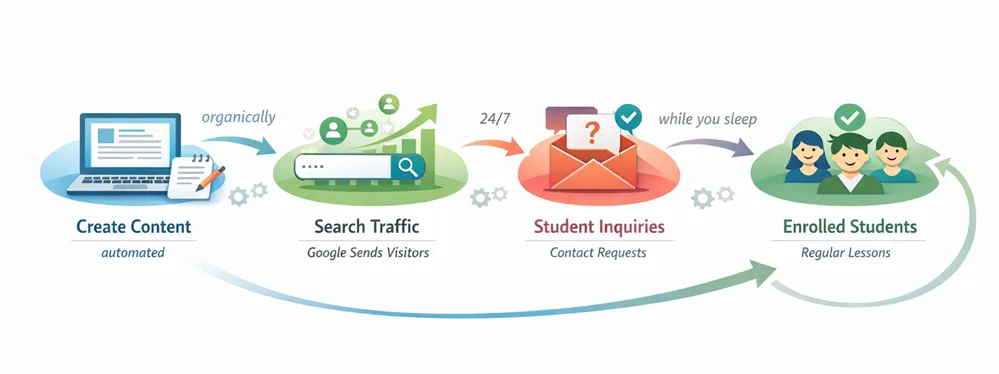
When you focus on student acquisition as a skill, you stop guessing. You create assets. You build something you own. A website, helpful content, and clear pathways give you control over how students find you and why they choose you.
This approach isn’t about working harder. It’s about working once and letting the results compound.
If you want the full step-by-step picture of turning this into a real business, the next move is to read my How to Start Your Own Online ESL Teaching Business article. This article fits inside that larger framework and shows you how everything connects.
Some teachers use tools like Wealthy Affiliate to quickly set up their own website and learn things like creating content, and understanding search traffic. Not as a shortcut, but as support while they build their own system.
In the long run, systems beat hustle. And ownership beats dependency every time.