

There’s a certain rush that comes with finding an affiliate program that looks perfect. The product fits your niche, the commission rate looks solid, and signing up takes about two minutes.
So you jump in.
That rush is exactly what gets new affiliates into trouble.
Most people spend more time picking a Netflix show than they do vetting an affiliate program. And then months later, they’re wondering why they’re not getting paid, why it isn’t converting, or why the program they built content around suddenly went quiet.
The good news is that most bad affiliate programs telegraph their problems early. You just have to know what to look for before you commit your time and your audience’s trust to them.
This guide walks you through the biggest red flags to watch for when evaluating any affiliate program so you can make smarter decisions from the start.
This post may contain affiliate links. ThriversHub earns commissions at no extra cost to you when purchases are made through links on this page. For more info, visit the disclosure page.
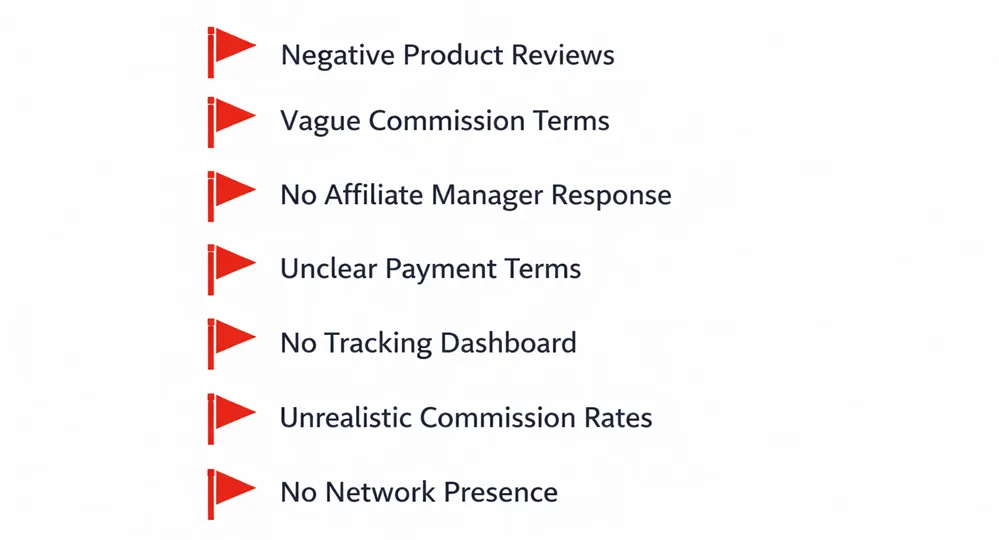
Red Flag #1: The Product Has Mostly Negative Reviews
When you promote a product as an affiliate, you’re putting your name behind it. If someone buys based on your recommendation and has a terrible experience, that reflects on you, not just the company.
This is why checking the product’s reputation isn’t optional. It’s one of the most basic forms of research you should do before joining any program, and it’s something a lot of new affiliates skip entirely.
So what does “mostly negative reviews” actually look like?
It’s not always one-star ratings across the board. Sometimes it’s a pattern of complaints about the same issue – poor customer support, products that don’t match the description, refund requests that go ignored.
Check independent review sites like Trustpilot, G2, or even Reddit. Look at what real customers are saying, not just the testimonials on the company’s own website.
A few negative reviews are normal for any product. What you’re looking for is volume and pattern. If the complaints are consistent and recent, that’s your signal to keep moving.
Promoting a product people don’t trust means you’ll be fighting an uphill battle on every piece of content you create. Even if you drive traffic, conversions will suffer. And if customers feel misled, some of them will come back to tell you about it.
Red Flag #2: The Commission Terms Are Vague or Suspiciously Complicated
A legitimate affiliate program should be able to tell you clearly how you get paid, how much you get paid, and when.
If you have to dig through three pages of documentation just to figure out the basic commission structure, that’s a problem.
Vague terms usually show up in a few specific ways. The commission rate might be listed as a range with no explanation of what determines where you land in that range. The cookie duration might not be mentioned at all. Payment thresholds, the minimum balance you need to reach before they’ll cut you a check, might be buried or left out entirely.
Complicated isn’t always the same as vague, but it can be just as dangerous. Some programs layer in so many conditions – clawbacks, approval periods, category exclusions – that by the time a sale actually counts toward your balance, it barely resembles what was advertised.
Always read the terms before you start promoting, not after.
A good habit is to go into the affiliate agreement looking for answers to four basic questions:
- What’s the commission rate?
- How long does the cookie last?
- What’s the payment threshold?
- And when do they pay?
If any of those answers are hard to find or hard to understand, that tells you something. Check out my guide on what to look for in affiliate terms and conditions walks through exactly what to check and what the numbers actually mean.
Red Flag #3: You Can’t Get a Response From the Affiliate Manager
This one is personal for me.
Back in 2007, I joined an affiliate program for a company called Viatalk. It was a VoIP service or internet-based phone calls, and the program looked solid. I promoted it, and in the first month I made over $700 in commissions.
Then came the waiting.
The payment didn’t come when it was supposed to. I gave it some time, figured there might be a processing delay, and waited a little longer. Eventually I tracked down the affiliate manager’s contact info from their program details and sent an email. No reply. I tried again. Still nothing. For two years, I had no idea if I’d ever see that money.
I did eventually get paid. From what I could tell, they settled up with affiliates around the time they decided to revamp the whole program. But two years is a long time to wait on money you already earned, and the silence in between was the worst part. Not knowing whether someone was even aware you existed.
Here’s what that experience taught me.
Having access to an affiliate manager is something you should test before you’re dependent on them, not after. Before you go deep on promoting any program, try reaching out with a basic question. It doesn’t have to be anything complicated – ask about their cookie duration, or how they handle a specific tracking scenario. What you’re really checking is whether anyone responds, and how quickly.
A good affiliate program has someone you can actually talk to. If the only contact option is a generic form that goes nowhere, or if emails consistently go unanswered, that’s not a program you want to be building content around.
Red Flag #4: The Payment Terms Are Long, Unclear, or Always “Delayed”
Connected to the last point but worth separating out, because sometimes an affiliate manager is perfectly reachable, and the payment terms are still a mess.
Every affiliate program has a payment schedule, and most have a minimum threshold you need to hit before they’ll process anything. That’s normal. What’s not normal is when those terms are structured in a way that consistently works against you.
Net-30 payment terms mean they pay you 30 days after the end of the month in which you earned the commission. That’s fairly standard. Net-60 is on the longer side but still common in certain industries. Net-90 should give you pause – that’s three months after you’ve already done the work. And some programs push beyond even that.
Long payment windows aren’t automatically disqualifying, but they become a red flag when combined with other warning signs like vague terms, a high payment threshold, or a history of complaints from other affiliates.
Speaking of which, it’s worth doing a quick search before you join any program. Look up the program name alongside words like “not paid,” “delayed payment,” or “affiliate complaint.” Forums, Facebook groups, and affiliate marketing communities are full of people sharing firsthand experiences, good and bad.
Also pay attention to what happens when something goes wrong. Does the program have a clear dispute process? Is there any accountability built in, or does it all come down to trusting that someone will do the right thing?
Programs that run through established affiliate networks have an extra layer of accountability built in by default, which is one of the reasons joining a reputable network is worth considering, especially when you’re starting out.
Red Flag #5: There’s No Real Tracking or Dashboard
Some affiliate programs give you nothing but a link.
No dashboard, no click stats, no conversion data – just a URL and the hope that someone on their end is keeping track.
I ran into this firsthand with a program for a company called BackBlaze, a cloud backup service. Looked like a decent fit for my audience, so I signed up and started promoting.
But there was no real affiliate dashboard to speak of. No way to see if clicks were being recorded, no conversion data, nothing to tell me whether any of my efforts were actually translating into sales.
I never knew if I made a single sale. And eventually, they shut the program down entirely.
That experience is more common than it should be. And the problem isn’t just that you’re flying blind. It’s that without tracking, there’s no accountability on either side. You can’t optimize what you can’t measure, and you have no way to verify that commissions are being recorded accurately even if sales are happening.
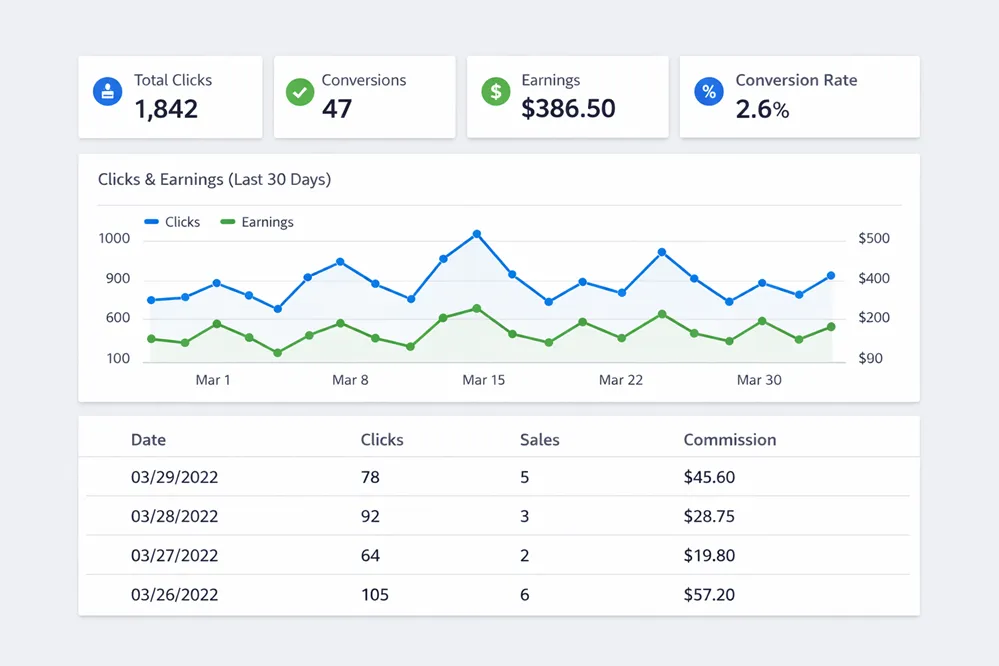
A legitimate affiliate program should give you access to real-time or near-real-time stats at minimum. You want to see clicks, conversions, and earnings broken down clearly.
Some programs go further with sub-ID tracking, conversion rate data, or even creative performance stats, and that’s a good sign. It means they’re invested in helping you succeed, not just collecting traffic from you.
Before you commit to promoting any program, log into the affiliate dashboard and take a look around. If it feels like an afterthought, or worse, if there’s barely anything there, treat it as a warning sign.
Your time is worth more than a link and a prayer.
Red Flag #6: The Commission Rate Seems Too Good to Be True
High commissions aren’t automatically a red flag. Software and digital products often pay 30%, 40%, even 50% because their margins allow it. So this isn’t about avoiding high-paying programs, it’s about knowing when a number stops making sense.
If a program is offering 70% or 80% commission on a physical product, ask yourself how that’s possible.
Physical products have manufacturing costs, shipping, storage, and returns to account for. The math rarely works at those rates, which means something else is going on. Sometimes it’s a short-term promotion designed to recruit affiliates fast. Sometimes the product is priced artificially high to make the commission look impressive while the actual payout is ordinary. And sometimes it’s a sign that the program isn’t built to last.
The same logic applies to recurring commissions that seem inflated with no clear explanation. A SaaS product offering 80% recurring lifetime commissions sounds incredible but a business can’t survive long-term giving away that much of its revenue. Either the product is underpriced, the terms will change once they’ve built their affiliate base, or there’s fine print that makes that number much harder to actually collect than it appears.
What you’re looking for is a commission structure that makes sense for the product type and business model. Reasonable recurring commissions on software, percentage-based commissions on physical goods that reflect realistic margins, one-time payouts on services that align with customer lifetime value.
When a number feels designed to impress rather than reflect reality, that instinct is usually worth listening to.
Red Flag #7: The Program Has No Network Presence and No Reputation to Speak Of
Not every legitimate affiliate program runs through a network. Plenty of solid in-house programs exist, and some of the best ones are managed directly by the company. So this isn’t a rule. It’s a context clue.
The issue is when a program has no network presence, no reviews from other affiliates, no mentions in forums or communities, and no track record you can verify anywhere.
That combination means you’re essentially taking their word for everything – how they track, how they pay, and whether they’ll still be running the program six months from now.
Affiliate networks like PartnerStack, CJ Affiliate, or Impact add a layer of accountability that in-house programs don’t always have.
When a program is listed on a reputable network, there’s a third party involved in tracking and often in payment processing too. If something goes wrong, you have somewhere to escalate. These are some of the best affiliate networks worth looking at if you want a starting point for finding programs with that kind of structure behind them.
For in-house programs, the vetting process just has to be more thorough on your end. Look for the program being mentioned by real affiliates in Facebook groups, Reddit threads, or marketing forums. Search for payment proof.
Check how long the company itself has been around. A brand new business with a brand new affiliate program and zero reviews is a much riskier bet than an established company with a verifiable track record.
The less third-party accountability a program has, the more homework you need to do before trusting it with your time and your audience.
Final Thoughts
Vetting an affiliate program doesn’t have to take long. Twenty minutes of research before you commit can save you months of wasted content, unpaid commissions, and the frustration of building around something that was never going to work out.
The red flags in this guide aren’t rare edge cases. Negative product reputations, silent affiliate managers, missing dashboards, payment terms that never quite add up are things affiliates run into regularly, especially when they’re still learning what to look for. The fact that you’re looking for them now puts you ahead of where most people start.
That said, knowing the red flags is one piece of it. Understanding how affiliate marketing actually works takes more than a checklist.
If you’re still building that foundation, Wealthy Affiliate is a great place to be. It’s where I got my own training when I was starting out, and it’s still the most structured resource I recommend to people who are serious about doing this properly.

One thing that makes it particularly useful is the community. Throughout this article, I kept pointing you toward forums and communities where real affiliates share experiences – that’s exactly the kind of environment Wealthy Affiliate has built in. You can ask questions, get feedback on programs you’re considering, and hear from people who’ve already been where you are.
You can read my full take on the platform in this Wealthy Affiliate review if you want to know what you’re getting into first.
There’s a free Starter account if you want to get in and look around before committing to anything.
No red flags on that one – I checked.


